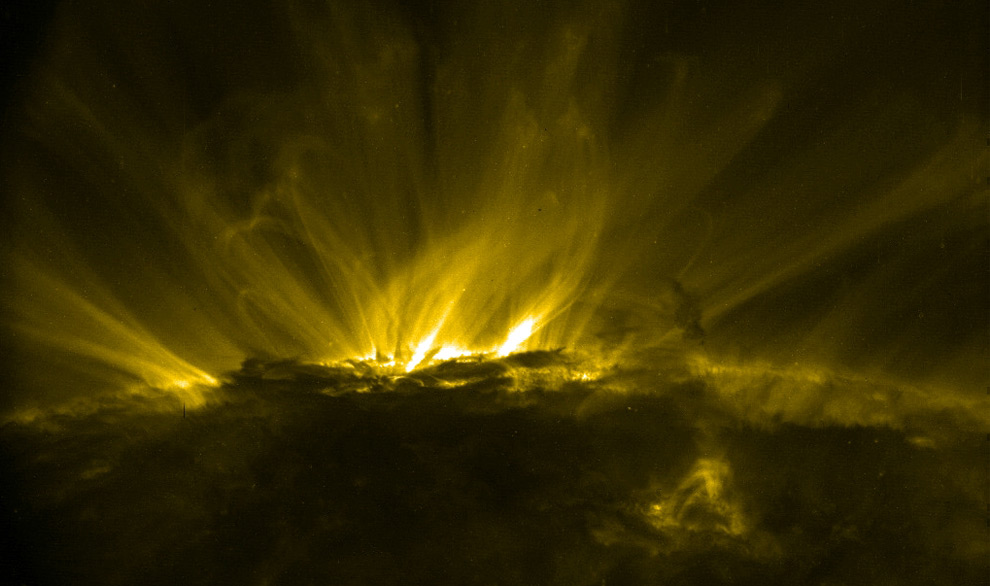
Boston Globe用大幅照片展示了罕见的平静太阳表面。太阳目前处于11年活跃周期中的最平静阶段,太阳极小期间——事实上,它平静的有点不寻常——过去200天里几乎没有看见几个黑子,太阳风也抵达了过去50年的最低潮。科学家不清楚这种不同寻常平静的含义。不过根据《新科学家》的报道,上周六,太阳表面出现了最近几周内的第三颗黑子,新黑子的涌现可能是太阳走出平静期的信号。未来几个月预计能观察到更多的黑子,可能表示新的太阳活跃期开始了,潜在的它也可能破坏地球轨道上的人造卫星和地面电网。
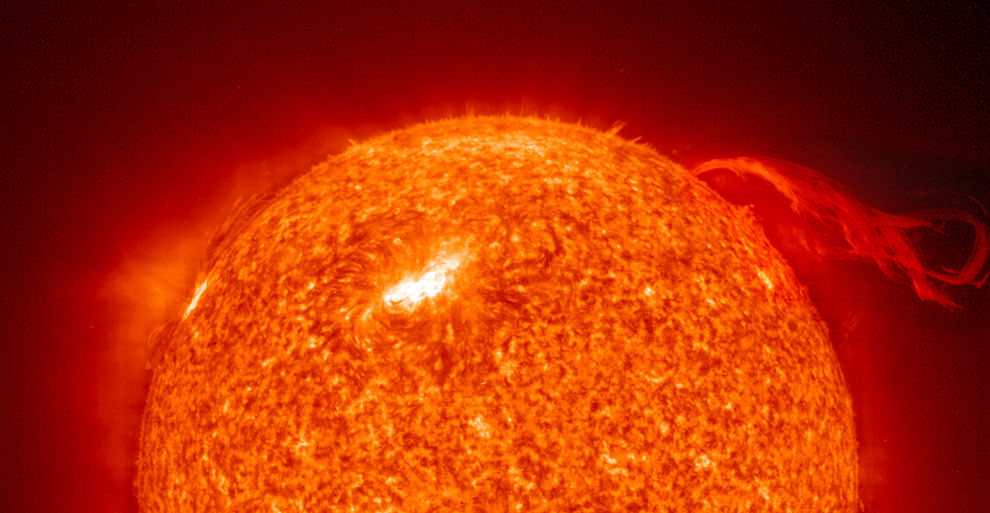
Asweeping prominence, a huge cloud of relatively cool dense plasma isseen suspended in the Sun's hot, thin corona. At times, promineces canerupt, escaping the Sun's atmosphere. Emission in this spectral lineshows the upper chromosphere at a temperature of about 60,000 degrees K(over 100,000 degrees F). Every feature in the image traces magneticfield structure. The hottest areas appear almost white, while thedarker red areas indicate cooler temperatures. (Courtesy of SOHO/EITconsortium)
2
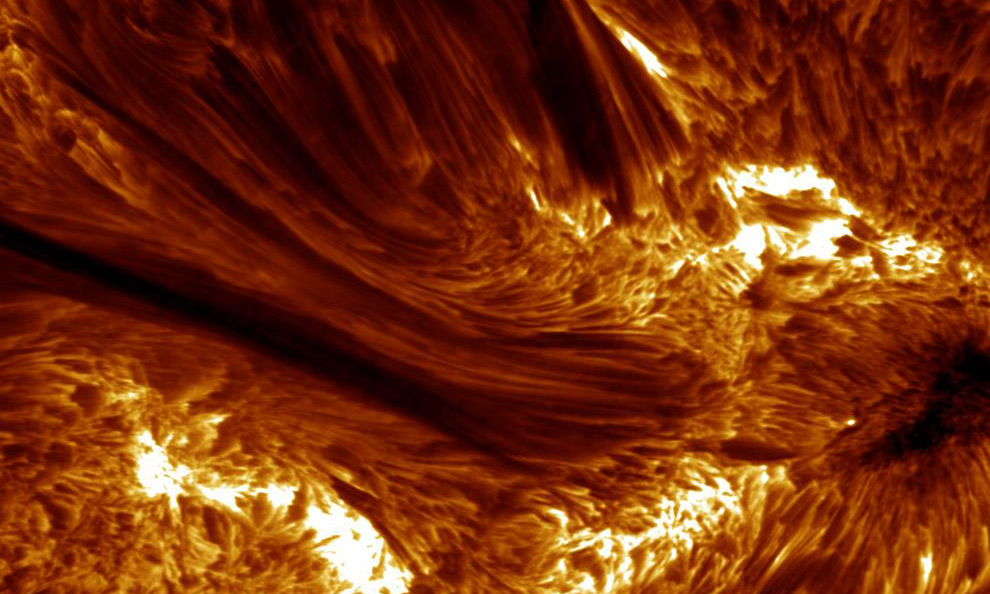
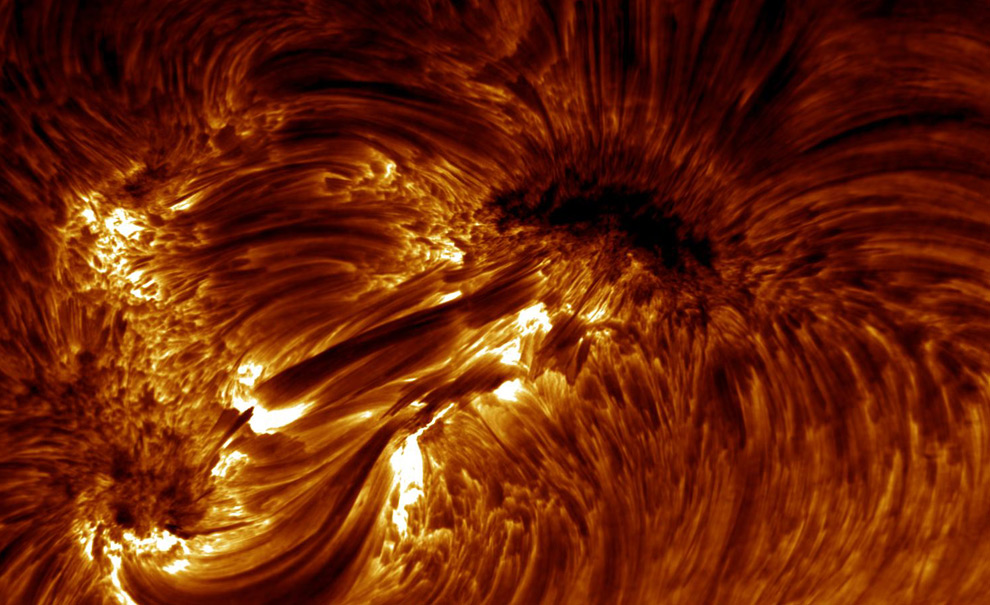
Detailedcloseup of magnetic structures on the Sun's surface, seen in theH-alpha wavelength on August 22, 2003. (Swedish 1-m Solar Telescope(SST) operated by the Royal Swedish Academy of Sciences, OddbjornEngvold, Jun Elin Wiik, Luc Rouppe van der Voort) #
3
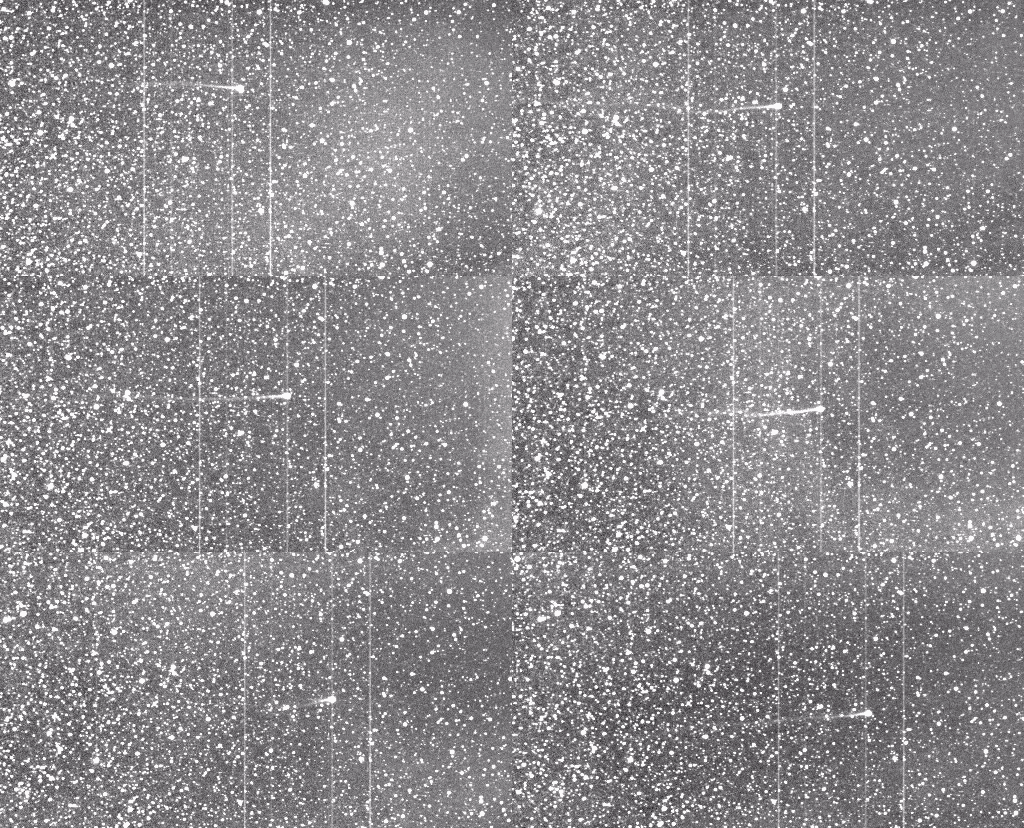
NASA'sSTEREO satellite captured the first images ever of a collision betweena solar "hurricane", called a coronal mass ejection (CME), and a cometon April 4, 2007. The collision caused the complete detachment of thecomet's plasma tail. Comets are icy leftovers from the solar system'sformation billions of years ago. They usually hang out in the cold,distant regions of the solar system, but occasionally a gravitationaltug from a planet, another comet, or even a nearby star sends them intothe inner solar system. Once there, the sun's heat and radiationvaporizes gas and dust from the comet, forming its tail. Cometstypically have two tails, one made of dust and a fainter one made ofelectrically conducting gas, called plasma. (NASA/STEREO) #
4
Imageof an active solar region taken on July 24, 2002 near the eastern limbof the Sun. The image highlights the three-dimensional nature of thephotosphere when seen at these large angles. The structures in the darksunspots in the upper central area of the image show distinct elevationabove the dark "floor" of the sunspot. The height of the structures hasbeen estimated by Dr. Bruce Lites of the High Altitude Observatory tobe between 200 and 450 km. The smallest resolvable features in theimage are about 70 km in size. There are also numerous bright "faculae"visible on the **s of granules that face towards the observer. (Prof.Goran Scharmer/Dr. Mats G. L鰂dahl/Institute for Solar Physics of theRoyal Swedish Academy of Sciences) #
5
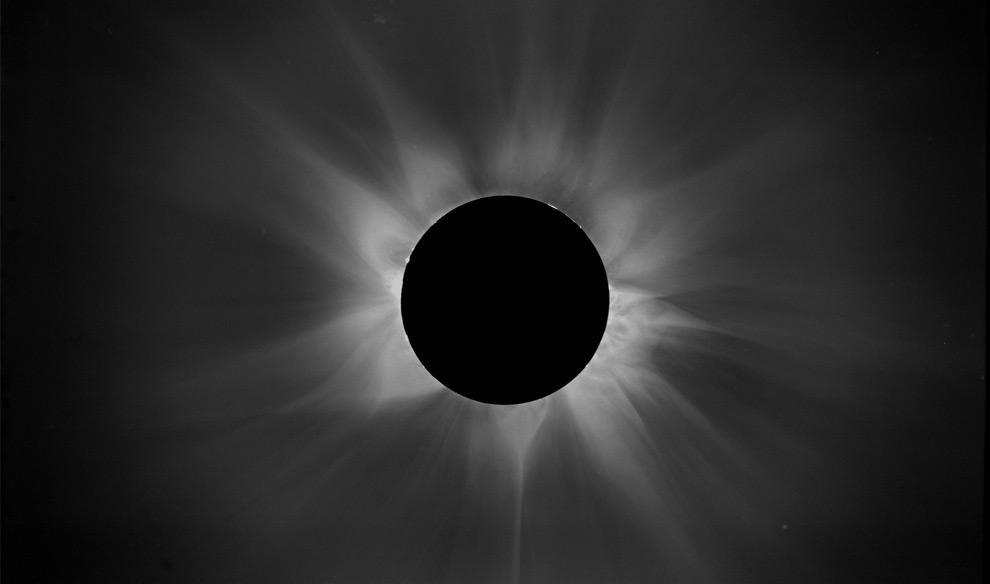
Thetotal solar eclipse of February 16, 1980 was photographed from Palem,India, by a research team from the High Altitude Observatory of theNational Center for Atmospheric Research. The photograph of the solarcorona was taken with a camera system developed by Gordon A. Newkirk,Jr. This specialized instrument photographs the corona in red light,6400 A -- through a radially graded filter that suppresses the brightinner corona in order to show the much fainter streamers of the outercorona in the same photograph. (Rhodes College, Memphis, Tennessee /High Altitude Observatory (HAO), University Corporation for AtmosphericResearch (UCAR)) #
6
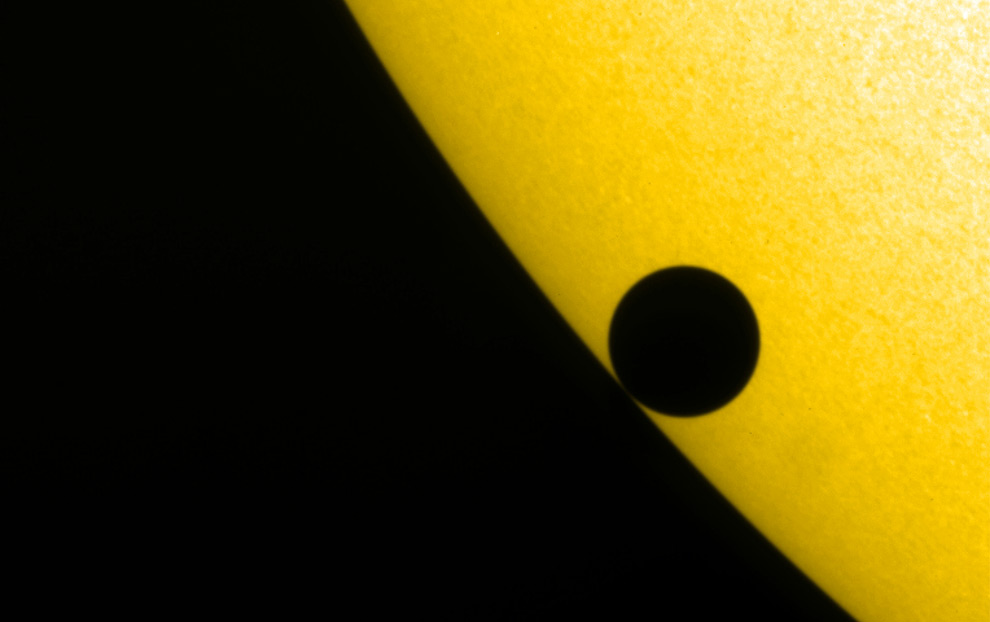
The planet Venus is seen by NASA's TRACE satellite, at the start of its transit across the sun on June 8, 2004. (NASA/TRACE) #
7
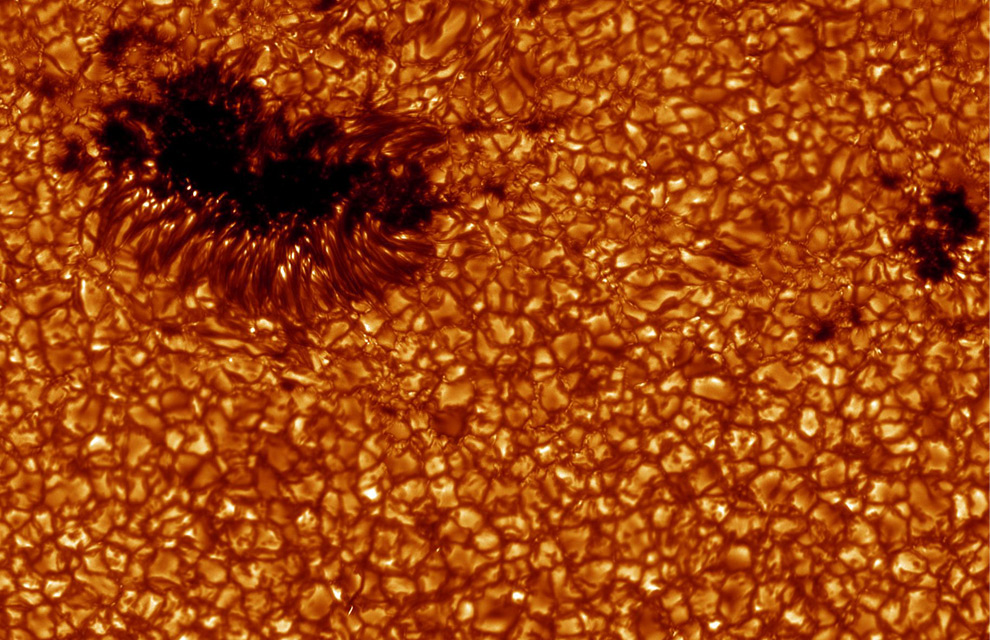
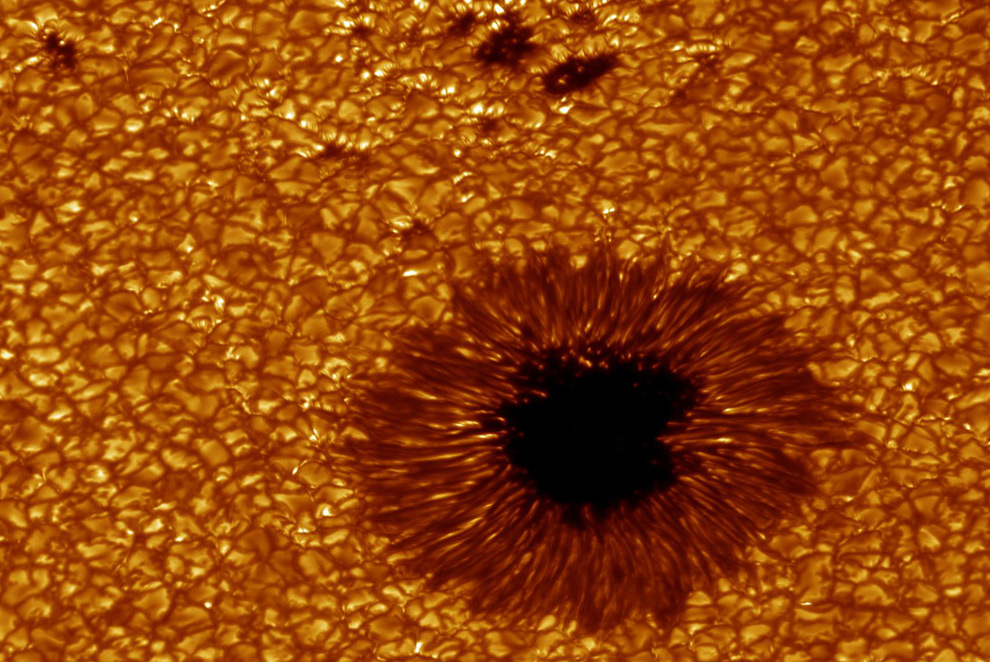
Aview of a sunspot and granules on the Sun's surface, seen in theH-alpha wavelength on August 4, 2003. (Swedish 1-m Solar Telescope(SST) operated by the Royal Swedish Academy of Sciences, G鰎an Scharmerand Kai Langhans, ISP) #
8
Solarflares produce seismic waves in the Sun's interior that closelyresemble those created by earthquakes on our planet. On May 27, 1998,researchers observed this flare-generated solar quake that containedabout 40,000 times the energy released in the great earthquake thatdevastated San Francisco in 1906, equivalent to an 11.3 magnitudeearthquake, scientists calculated. Over the course of an hour, thesolar waves traveled for a distance equal to 10 Earth diameters beforefading into the fiery background of the Sun's photosphere. Unlike waterripples that travel outward at a constant velocity, the solar wavesaccelerated from an initial speed of 22,000 miles per hour to a maximumof 250,000 miles per hour before disappearing. (Courtesy of SOHO/EITconsortium. SOHO is a project of international cooperation between ESAand NASA) #
9
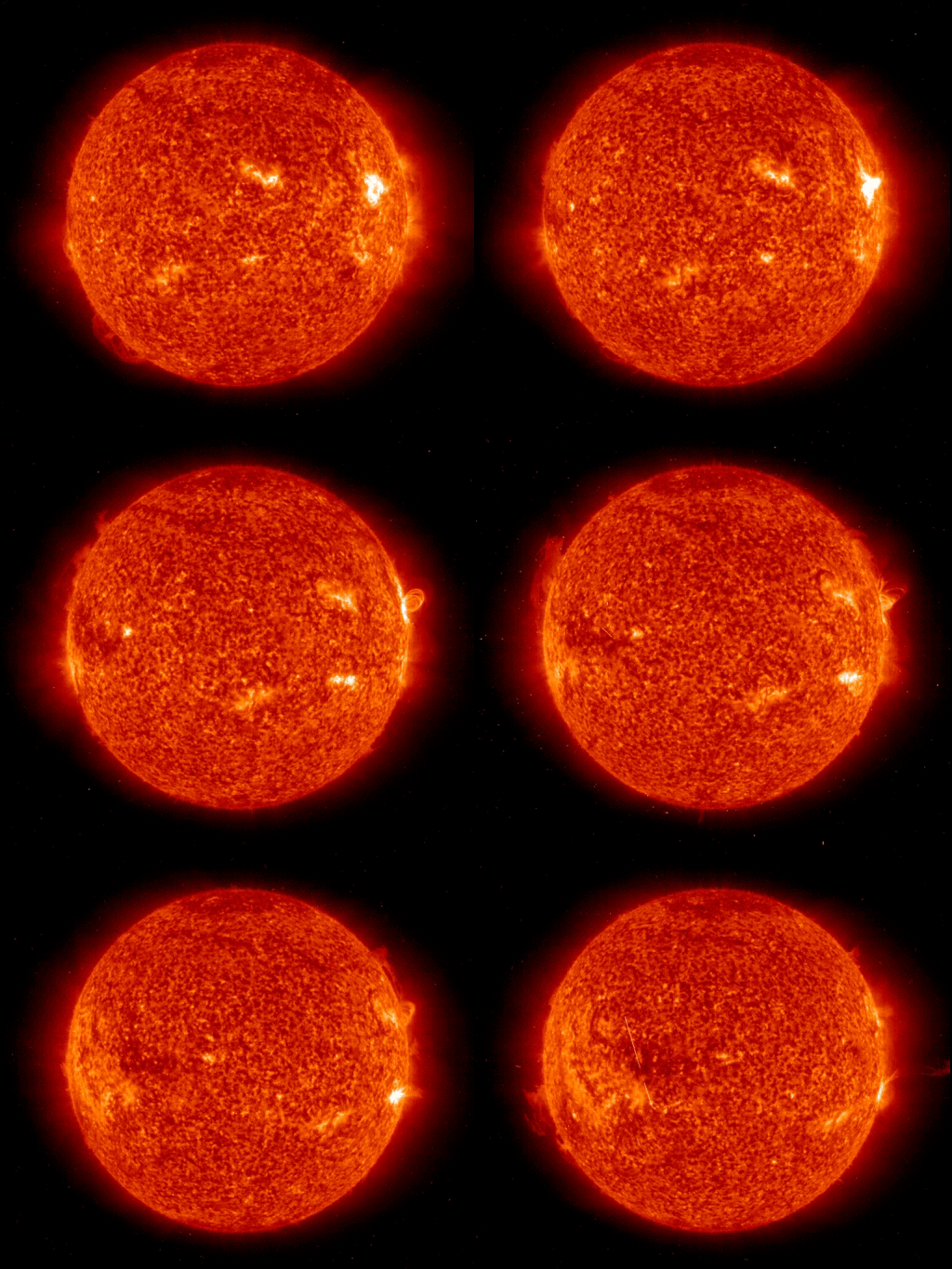
Ananimation of the sun, seen by NASA's Extreme ultraviolet ImagingTelescope (EIT) over the course of 6 days, starting June 27, 2005.(Courtesy of SOHO/EIT consortium) #
10
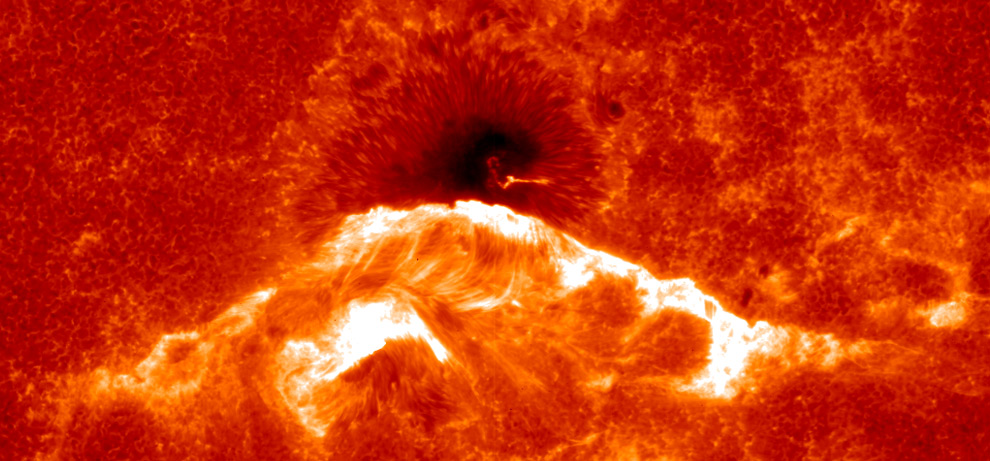
Hinode(formerly known as Solar-B) successfully captured a massive solar flareon 13 December 2006. It was one of the largest flares occurring in thatperiod of solar activity minimum. (JAXA/NASA/PPARC) #
11
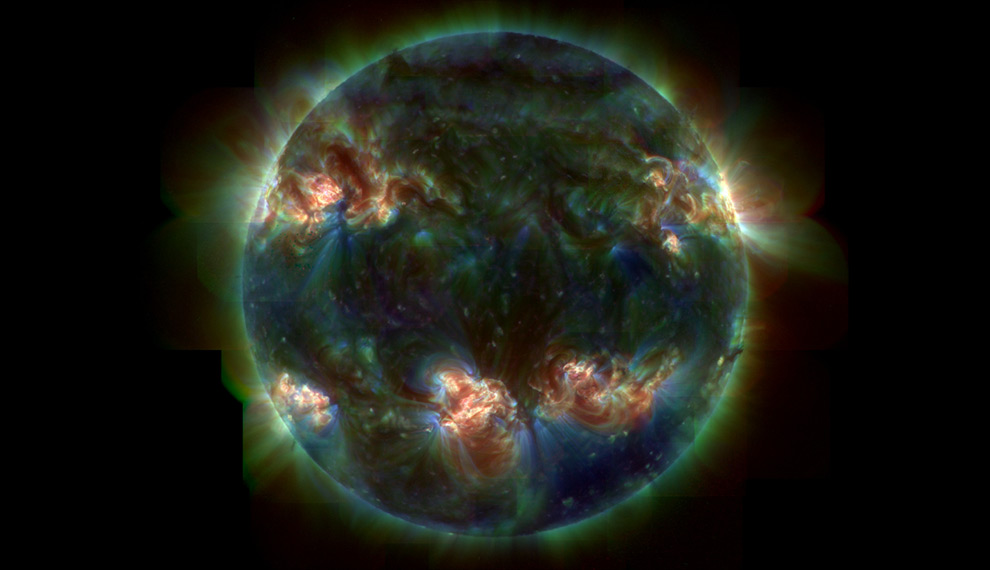
Theimage shows the corona for a moderately active Sun, with some (red) hotactive regions in both hemispheres, surrounded by the (blue/green)cooler plasma of the quiet-Sun corona. Notice also the northpolar-crown filament, the trans-equatorial loops, and the coronal holein the south-east (lower-right) corner of the image and the smaller oneover the north pole. This image shows the solar corona in afalse-color, 3-layer composite: the blue, green, and red channels showthe 171作者: Mallon 时间: 2008-10-15 10:39
12
Aview of an irregular-shaped sunspot and granules on the Sun's surface,seen on August 22, 2003. (Swedish 1-m Solar Telescope (SST) operated bythe Royal Swedish Academy of Sciences, Oddbjorn Engvold, Jun Elin Wiik,Luc Rouppe van der Voort, Oslo) #
13
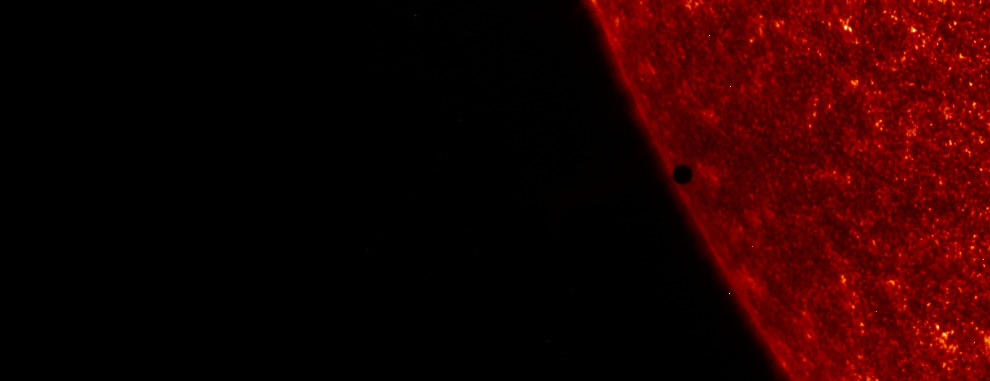
On November 8, 2006, Mercury is seen, beginning a transit in front of the Sun. (NASA/TRACE) #
15
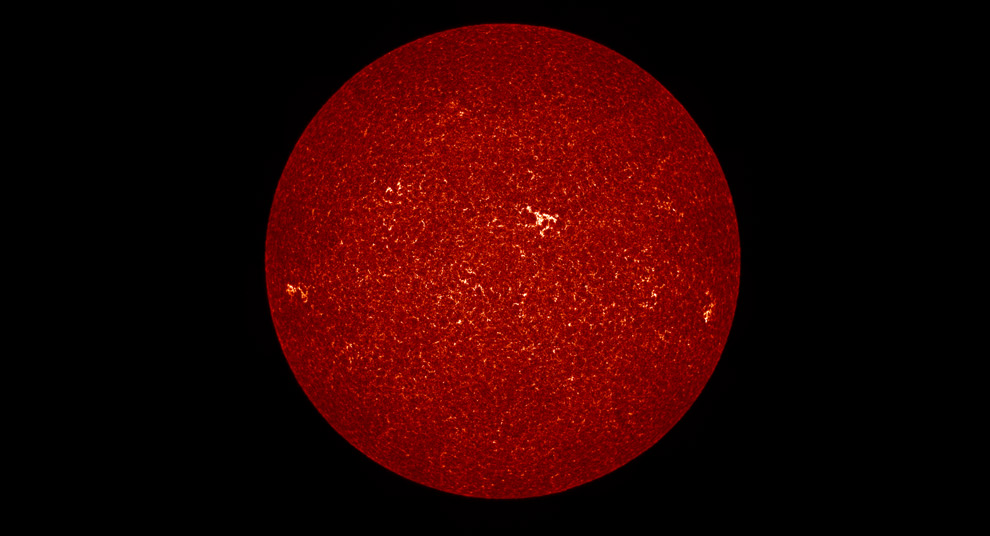
TheSun, observed on May 22, 2008. With the Sun persisting in anear-minimal state of activity, only a few small regions of someactivity are seen on the disk. The cell-like appearance is formed bythe multitude of small clusters of magnetic flux that are collected inthe downflow regions of the supergranular network of convectivemotions. (NASA/TRACE) #
17
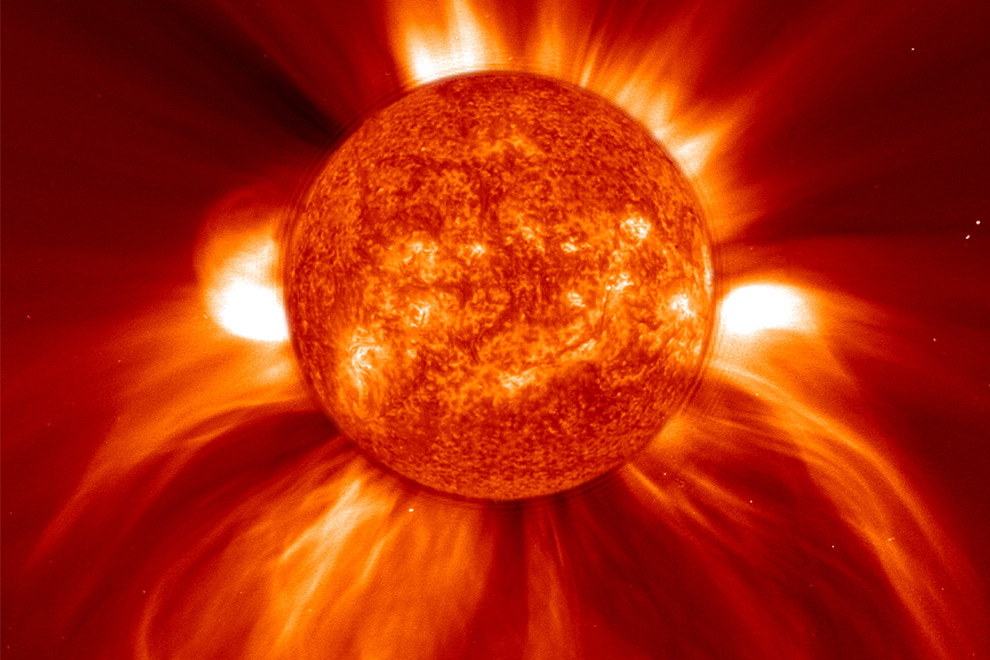
ThisLASCO C2 image, taken 8 January 2002, shows a widely spreading coronalmass ejection (CME) as it blasts more than a billion tons of matter outinto space at millions of kilometers per hour. The C2 image was turned90 degrees so that the blast seems to be pointing down. An EIT 304Angstrom image from a different day was enlarged and superimposed onthe C2 image so that it filled the occulting disk for effect (Courtesyof SOHO/LASCO consortium) #
18
Detailedcloseup of magnetic structures on the Sun's surface, seen in theH-alpha wavelength on August 22, 2003. (Swedish 1-m Solar Telescope(SST) operated by the Royal Swedish Academy of Sciences, OddbjornEngvold, Jun Elin Wiik, Luc Rouppe van der Voort, Oslo) #
19
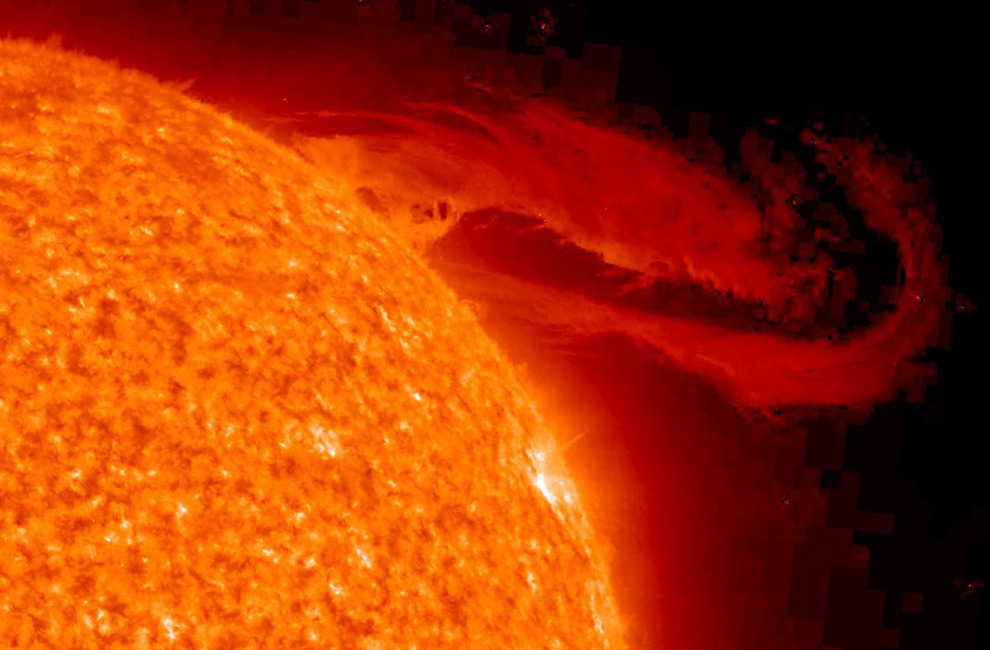
NASA'sSTEREO (Ahead) spacecraft observed this visually stunning prominenceeruption on Sept. 29, 2008 in the 304 wavelength of extreme UV light.It rose up and cascaded to the right over several hours, appearingsomething like a flag unfurling, as it broke apart and headed intospace. The material observed is actually ionized Helium at about 60,000degrees. Prominences are relatively cool clouds of gas suspended abovethe Sun and controlled by magnetic forces. (NASA/STEREO) #
20
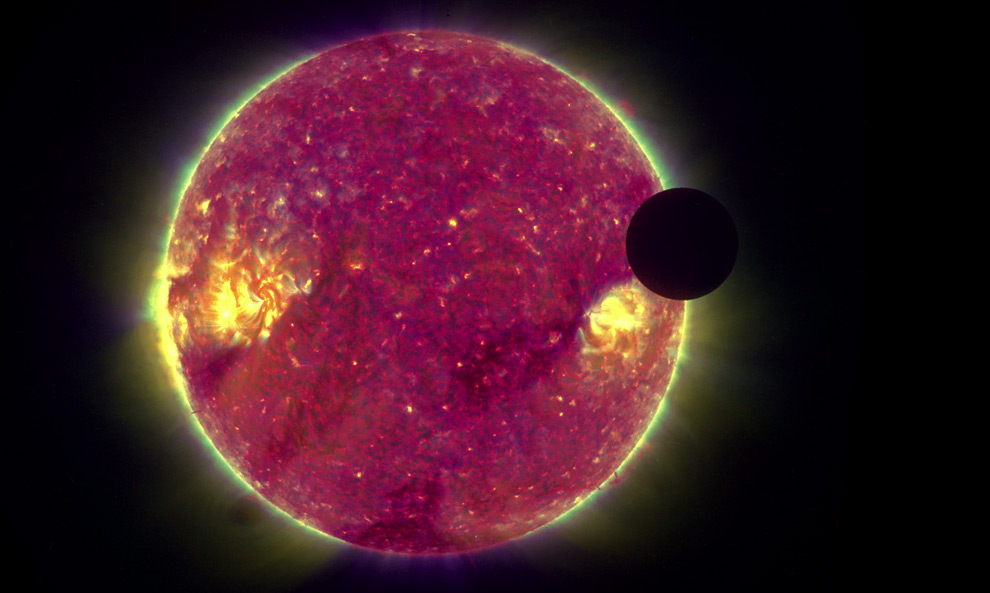
Atransit of the Moon across the face of the Sun on February 25, 2007 -but not seen from Earth. This sight was visible only from the STEREO-Bspacecraft in its orbit about the sun, trailing behind the Earth.NASA's STEREO mission consists of two spacecraft launched in October,2006 to study solar storms. STEREO-B is currently about 1 million milesfrom the Earth, 4.4 times farther away from the Moon than we are onEarth. As the result, the Moon appears 4.4 times smaller than what weare used to. (NASA/STEREO) #
21
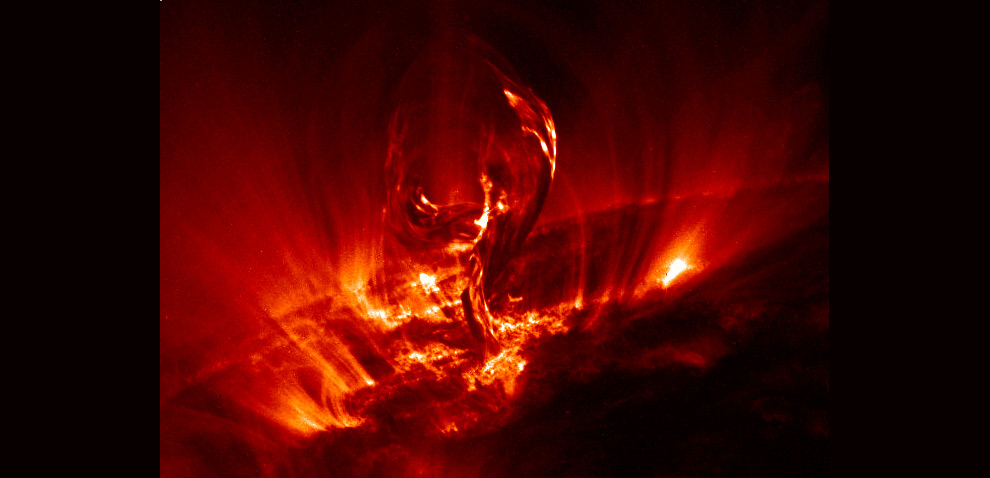
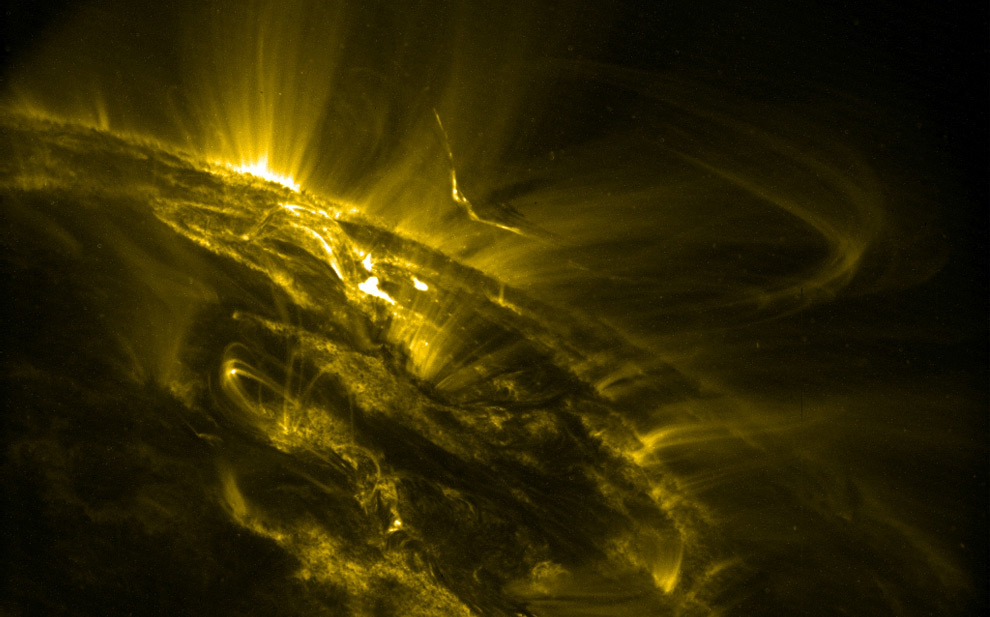
OnSeptember 30, 2001, TRACE observed an M1.0 flare in an active regionvery near to the solar limb. Fragments of a prominence hovered abovethe regions, with filamentary dark (relatively cool) material movingalong the field lines, which then spread to form this dragon-likebright outline. (NASA/TRACE) #作者: 月光不锈 时间: 2008-10-15 11:54

 3
3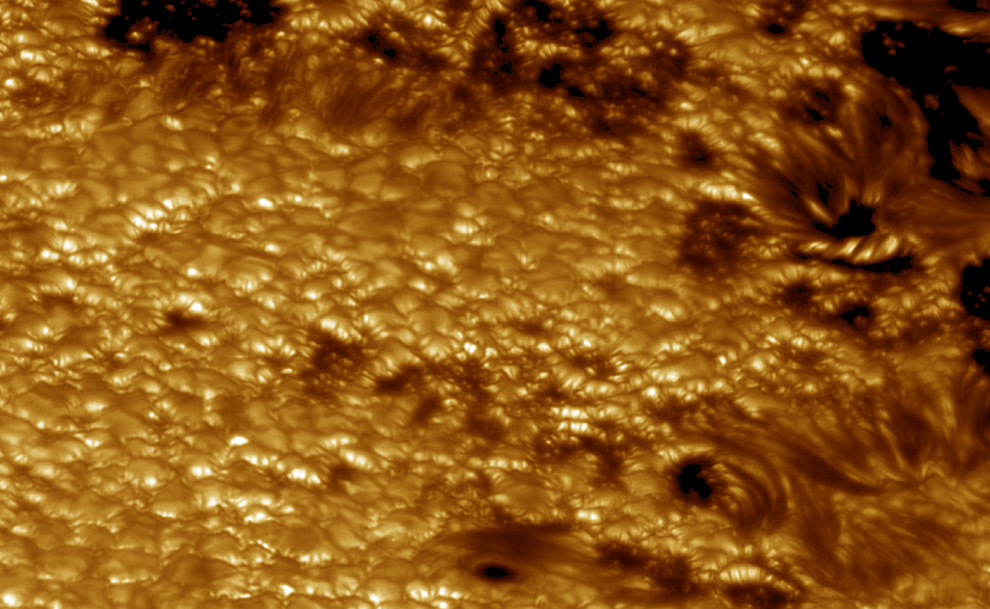

 9
9